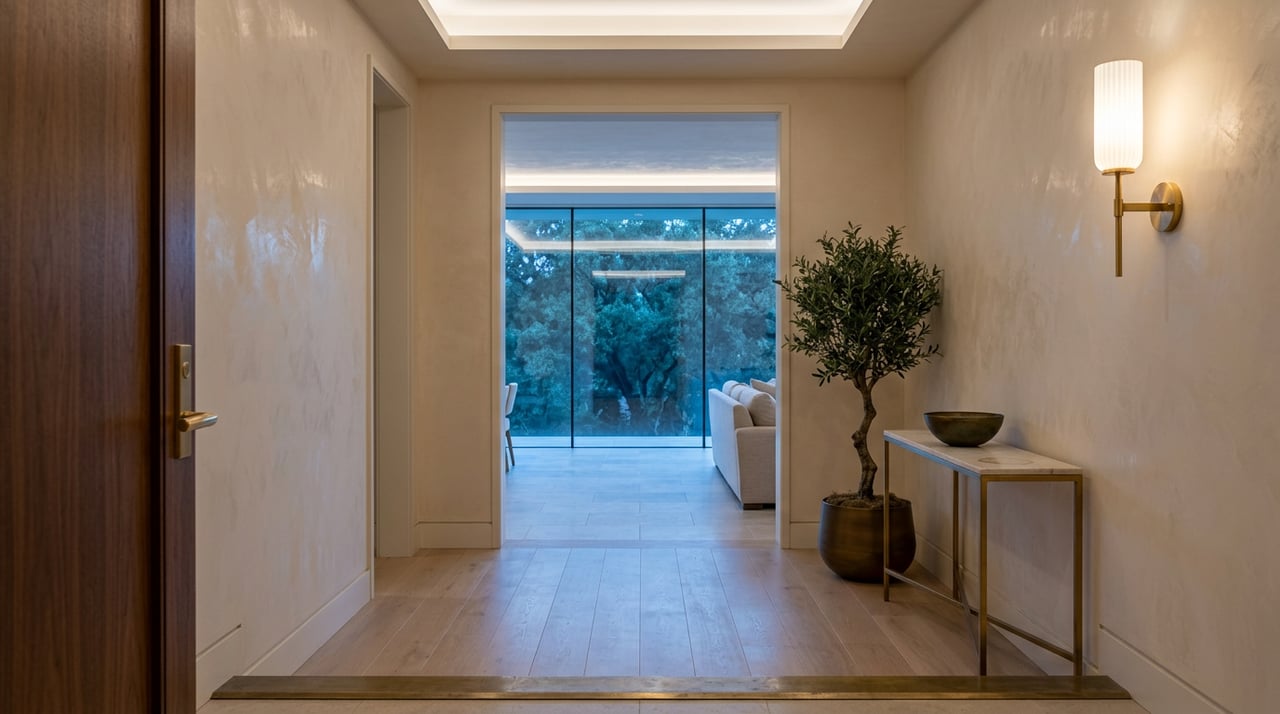
For three and a half years, the corner of Tanglewood Boulevard and San Felipe generated more legal fees than square footage. The Tanglewood Homes Association sued to stop a condo tower from replacing the low brick building that had served as Tanglewood Corp's headquarters since the neighborhood itself opened in 1949. The argument turned on a technicality: the parcel had always been zoned for commercial use, but neighborhood amendments from 1997 seemed to allow only a single residence there, not a multi-unit tower. A Harris County judge finally cleared the project in October 2022. By then, the family's attorney put the legal bill at up to $2.5 million.
The building that emerged from that fight, 1661 Tanglewood, is now one of two new condo towers going up in the neighborhood at nearly the same time. The other, a much smaller project called The Beverly, sits a short drive away at 5010 Longmont Drive with none of that history behind it. Both are being sold to the same buyer: a Tanglewood homeowner who wants to stop mowing a lawn without leaving the zip code. Neither developer agrees on what that buyer actually wants.
Seventy Years Before Anyone Broke Ground
Kendall Miller, the grandson of Tanglewood's original developer William Farrington, grew up a bike ride from the office his family is now tearing down. He lives in his grandfather's old house nearby, the same one his mother, Mary Catherine Miller, moved into after Farrington died. Kendall moved in himself after his mother's death in 2018, and it was that loss that pushed the family to rethink what to do with the corner office building they'd occupied for nearly 70 years. What came out of that decision was a 34-story tower with 59 residences, designed by Jackson & Ryan Architects with interiors by J. Randall Powers, built by Tellepsen Construction, and listed exclusively through Martha Turner Sotheby's International Realty when sales launched in the fall of 2022.
The scale tells you who Miller thinks he's building for. Unit sizes run from around 2,800 square feet up to roughly 12,500 square feet, with most landing near 5,650 square feet, closer to a single-family home than a typical Houston high-rise unit. The building includes a 75-foot rooftop pool, a private event space called the Farrington Room, a guardhouse at the entrance, and full-time door and lobby staff. When 2021 pricing guidance put entry costs at upward of $3 million, the framing from the design team was explicit: this building isn't for someone who wants to shrink. It's for someone who wants the square footage of a house with none of the maintenance.
Public construction-permit records showed the project still moving through design and construction review as recently as January 2026, with no confirmed completion date attached. Given the legal delay that pushed groundbreaking well past its original spring 2023 target, that's not surprising. It does mean that, as of this writing, 1661 Tanglewood's timeline remains less settled than the smaller building rising elsewhere in the neighborhood.
A Different Bet, One Neighborhood Away
The Beverly has no lawsuit in its history. It's also a fraction of the size: seven stories, one residence per floor, six units total. Developed by RAMA Co. and G.T. Leach Constructors, with Mirador Group as architect, it's the first new mid-rise condominium tower Tanglewood has seen in several years. Where 1661 Tanglewood is selling scale, The Beverly is selling scarcity and resilience. Each unit runs just over 4,300 square feet with a private terrace, accessed by its own elevator bank into a private foyer with no shared hallway. And every residence comes with a dedicated 26-kilowatt Generac generator wired to a gas line, plus a separate generator that keeps the building's elevators and emergency lighting running independent of the grid.
That generator detail isn't incidental. As of August 2025, only about ten condominiums and townhomes listed anywhere in Houston advertised a generator as a feature, according to the Houston Association of Realtors. Whole-home backup power has become common in single-family listings, climbing from 518 homes in 2018 to 1,928 by 2024, but it had barely reached the condo market at all. The Beverly built its entire pitch around being one of the first to close that gap.
Pricing for the remaining units started at $3.5 million as of last summer, and public listings for individual full-floor residences have ranged from roughly $3.35 million to just under $4 million depending on floor level. The building's own marketing has shifted its delivery date more than once, moving from an April 2026 target to June, and now to a September 2026 window on its own site. That kind of slippage is normal for boutique luxury construction, but it's worth knowing if you're timing a move around it.
| 1661 Tanglewood | The Beverly | |
|---|---|---|
| Height | 34 stories | 7 stories |
| Total residences | 59 | 6 |
| Typical unit size | ~5,650 sq ft (range 2,800–12,500) | ~4,300 sq ft + 368 sq ft terrace |
| Starting price | Upward of $3 million (2021 guidance) | $3.5 million |
| Developer | Tanglewood Corp / Farrington-Miller family | RAMA Co. and G.T. Leach Constructors |
| Architect | Jackson & Ryan Architects | Mirador Group |
| Signature feature | 75-ft rooftop pool, Farrington Room | 26 kW whole-home Generac generator |
| Legal history | Homes Association lawsuit, resolved 2022 | None reported |
| Expected delivery | Undetermined as of early 2026 | September 2026 per developer |
What the Price Gap Actually Buys
Run the numbers on entry pricing and a real gap appears. 1661 Tanglewood's smallest advertised units, around 2,800 square feet, were guided at roughly $3 million, which works out to somewhere near $1,000 a square foot before the building's larger units are even factored in. The Beverly's listed full-floor units, at just over 4,300 square feet and priced between $3.35 million and $3.95 million, land closer to $780 to $900 a square foot.
That's not a small difference, and it's not really about the buildings competing on value. It's about what each price is buying. At 1661 Tanglewood, part of what a buyer pays for is staffing and shared infrastructure: door attendants, a guardhouse, an amenity floor built to host events, a full concierge presence. J. Randall Powers, the interior designer on the project, described the buyer he had in mind as someone moving from a River Oaks house who told him flatly she had 140 pairs of shoes and a grand piano and wasn't parting with either. That's a buyer paying to not downsize at all, just to stop maintaining a yard.
"I did a penthouse for a couple moving from a house in River Oaks. I sat down with them, and the wife said, 'I have 140 pairs of shoes and a grand piano and I'm not getting rid of any of it.'"
At The Beverly, the premium buys something closer to isolation and hardened infrastructure. Six units total means six sets of neighbors, full stop. No shared corridors. A generator system built for a grid that has failed Houston more than once in recent years. Nancy Almodovar of Nan and Co. Properties, who's marketing the building, has described the concept to buyers as "elevated bunkers in the sky," a phrase that captures the pitch better than any square-footage comparison could.
Which Anxiety Are You Actually Paying to Solve
If you're comparing these two buildings on price alone, you're comparing the wrong thing. The real question is which discomfort you're trying to remove. If the thought of losing your dining room, your closet space, or your ability to host twelve people for dinner is what's stopping you from selling your house, 1661 Tanglewood is built around exactly that anxiety. The unit sizes exist so a Tanglewood homeowner never has to feel the loss.
If the anxiety runs the other direction, toward exposure during a grid failure, toward shared hallways and unfamiliar neighbors, toward wanting fewer moving parts rather than more amenities, The Beverly is the more direct answer. Its entire design brief, down to the generator spec, is about removing the things that make high-rise living feel less secure than a house.
Neither building is objectively the better deal, because they were never designed to be compared on price per square foot in the first place. They were designed to solve two different problems that happen to share a zip code and a target buyer.
Frequently Asked Questions
Is 1661 Tanglewood actually replacing the Tanglewood Corp office building? Yes. The tower occupies the same 1.3-acre corner where the Farrington-Miller family's development office stood since the neighborhood opened in 1949, at Tanglewood Boulevard and San Felipe.
Did the Homes Association lawsuit change what could be built? The 2022 ruling allowed the project to proceed largely as designed. The dispute centered on whether 1997 deed-restriction amendments limited the site to a single residence, not on the tower's height or unit count directly.
Is The Beverly the only small-scale condo option near Tanglewood right now? It's described as the first new mid-rise condo tower Tanglewood has seen in several years, which points to genuine scarcity at that scale in this specific pocket, not that no comparable options exist anywhere in the broader Uptown area.
Comparing two buildings this different is exactly the kind of decision where a second opinion earns its keep, especially if you're weighing what you'd actually give up moving from a house into either one. If you're thinking through a move like this, Blake Kunetka can help you schedule a private consultation and walk the specifics against your own situation before you sign anything.