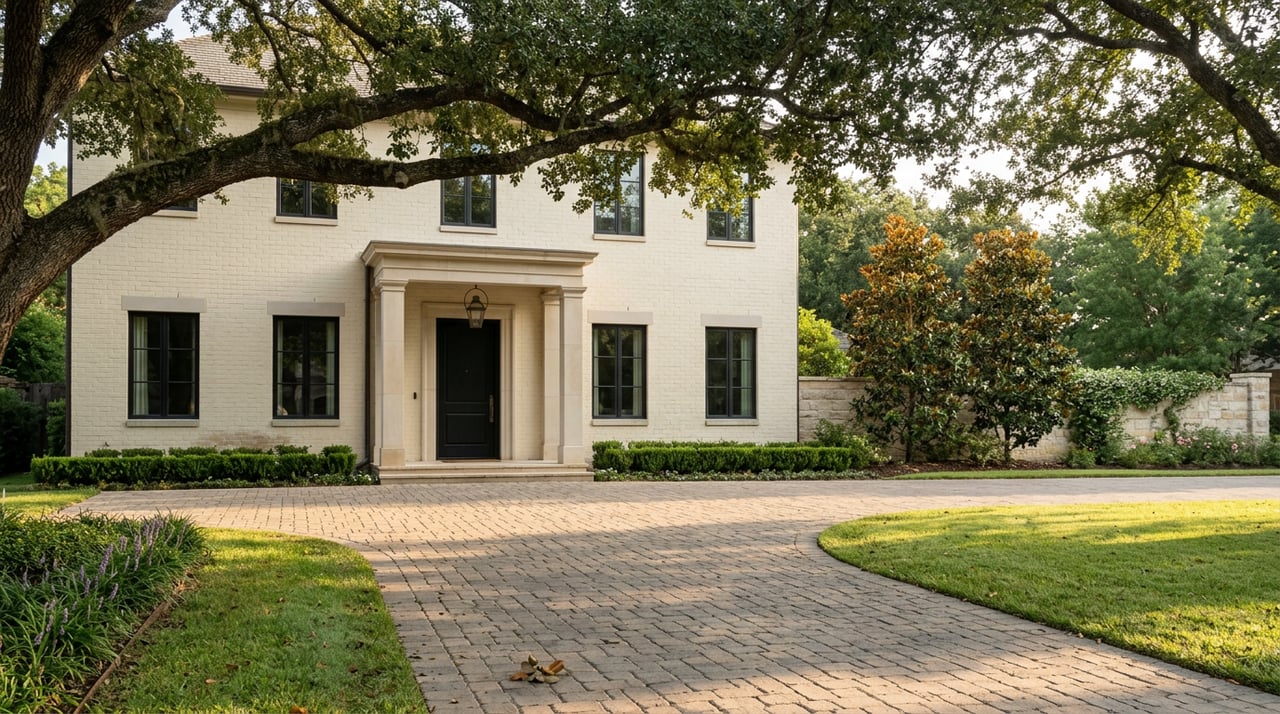
A River Oaks seller preparing for closing typically expects the usual paperwork: the contract, the survey, the title commitment. What often catches sellers and out-of-town buyers off guard is a separate document that has nothing to do with Harris County or the City of Houston. It comes from a private property owners association, it has its own price tag, its own processing time, and it is not optional. A second bill shows up again at the closing table itself. And if the buyer plans to build or renovate, a third layer of review begins after closing, one that has its own calendar and runs independently of any city permit.
Most people think of River Oaks' deed restrictions as a style guide: no aluminum siding, no chain-link fences, keep the trees. That's true, but it undersells what the restrictions actually are. They are an administrative system with fees, deadlines, and staff, run by an entity called River Oaks Property Owners, Inc. (ROPO), and that system touches a transaction at points most buyers never think to ask about until they're already under contract.
The Paper Before the Closing Table
Before a River Oaks home can change hands, the seller has to order a resale certificate from ROPO. According to ROPO's own published fee schedule, the certificate costs $375, takes 10 calendar days to prepare, and won't be started until the fee is paid. If a closing is happening faster than that, rush service is available for an additional charge. If a sale falls through and the same property comes back on the market within a year with no changes, the existing certificate can be updated for $100 rather than reissued from scratch.
That $375 typically falls to the seller, consistent with how River Oaks closing costs are commonly structured. A separate fee applies at the moment ownership actually changes hands: a $400 transfer fee, or $150 if the transaction is a refinance or a construction loan rather than a sale.
| Transaction Moment | Fee | Typically Paid By | Timing |
|---|---|---|---|
| Resale certificate (required before closing) | $375 | Seller | 10 calendar days; rush available |
| Certificate renewal (sale fell through, no changes, within a year) | $100 | Seller | On request |
| Ownership transfer | $400 | Negotiable, commonly buyer | At closing |
| Refinance or construction loan | $150 | Owner | At loan closing |
None of these numbers will break a River Oaks budget on their own. What they do is signal something buyers relocating from cities with looser HOA structures don't always anticipate: this neighborhood runs its own back office, separate from the county, and it has to be looped in before a title company can close.
The Review That Starts After You Own It
The fees are the easy part. The harder planning problem shows up after closing, if the plan is to build new or renovate significantly.
River Oaks' deed restrictions date to the 1920s and remain actively enforced, covering setbacks, height, exterior materials, and tree preservation. ROPO reviews plans for new construction and for substantial renovations through a Major Projects Application, a process separate from anything the City of Houston requires. Anyone pursuing that review has to contact ROPO's Deed Restrictions Department directly to request the application.
That second layer of review is the piece that catches people who assume a city permit is the finish line. A City of Houston permit clears the municipal side of a build. It does not clear the private side. Both have to happen, and they run on different clocks. Once permits are in hand, a realistic construction timeline for a River Oaks rebuild runs 18 to 24 months, and the deed restriction review has to be budgeted into that schedule from the start rather than treated as a formality that happens in parallel.
The restrictions were written to survive a century of Houston's booms and teardown cycles. They're still doing exactly that job, one resale certificate at a time.
Why the Trouble Is the Point
Here's the part that reframes the fees and the timeline rather than just listing them: the restrictions that cost buyers time and money are the same restrictions protecting the value of the land they're buying.
Lot size in River Oaks carries as much weight as square footage, sometimes more. Acre-plus lots inside the deed restrictions can carry $4 million to $7 million in land value alone before a house is ever built, and teardowns trading at $3 million or higher are common because builders price the rebuild against the underlying land, not the structure sitting on it. The tree canopy along River Oaks Boulevard has survived a century of redevelopment in large part because the restrictions govern what can be cleared, not just what can be built.
That protection shows up in the broader market picture too. River Oaks holds fewer than 1,300 single-family homes across roughly 1,100 acres, and inventory stays thin, with fewer than 25 homes typically listed at any given time across the Country Club Estates, Section One, and the boulevard itself. Median sale prices sit above $2.5 million as of mid-2026, with trophy estates regularly clearing $10 million and the top of the market reaching $30 million. A meaningful share of that activity happens off-market entirely, handled privately by agents who work the neighborhood full time rather than listed publicly.
Pricing varies considerably depending on where inside River Oaks a home sits. The estates along Lazy Lane, Inwood, and Del Monte regularly trade between $8 million and $25 million, and many of the originals still standing on Lazy Lane, Inverness Drive, and River Oaks Boulevard trace back to architects like John Staub, Birdsall Briscoe, and Joseph Finger. Side streets in Section Two, west of Willowick, run closer to $2 million to $6 million for renovated historic homes. The spread is wide, but the restrictions and the review process apply across all of it.
The Line Item That Isn't on the Settlement Statement
One more cost belongs in this conversation even though it never touches ROPO: property taxes. River Oaks carries an effective tax rate near 2.1% of assessed value, combining the City of Houston, HISD, Harris County, and other taxing entities. On a $2.5 million assessed home, that works out to roughly $52,000 a year before any exemptions. Cross into $5 million in assessed value and the annual bill crosses $100,000. Texas' homestead exemption can soften that over time for a primary residence, since it caps the year-over-year increase in appraised value at 10%, but the raw dollar figures are worth running before falling in love with a specific address.
None of these numbers, the resale certificate, the transfer fee, the review timeline, or the tax bill, show up on a listing sheet. They show up during the transaction, which is exactly why they're worth knowing before one starts rather than during it.
Frequently Asked Questions
Do the deed restrictions look the same across every section of River Oaks? The core themes, setbacks, materials, tree preservation, run through the neighborhood's restrictions broadly, but different sections were platted and filed at different times with their own specific documents. Anyone planning a renovation or rebuild should confirm the exact restrictions tied to that specific section rather than assuming one set applies neighborhood-wide.
Who actually pays the ROPO transfer fee, buyer or seller? Like most Texas closing costs, it's negotiable between the parties, though it's commonly handled as a buyer-side cost at closing. The resale certificate fee is the one more consistently assigned to the seller.
How far in advance should a buyer plan if they intend to build? Budget for the ROPO Major Projects Application and review as a separate track from city permitting, not a step that happens automatically alongside it. Combined with a realistic 18 to 24 month construction window once permits are issued, that means the timeline from purchase to move-in on a rebuild often runs well past two years.
Understanding where the friction actually lives, in the paperwork, the review process, and the tax bill, is what separates a smooth River Oaks purchase from one full of surprises. Blake Kunetka works this market from the inside, with a background in River Oaks new construction that means she's read this paperwork long before it lands on a client's desk. If you're weighing a purchase, a sale, or a rebuild inside River Oaks' deed restrictions, schedule a private consultation and get the full picture before you're under contract.